Przecinkowce a klimat – podsumowanie danych 2025

Rodzaj Vibrio obejmuje ponad 100 gatunków bakterii, z których około 12 powoduje zakażenia u ludzi zwane wibriozą.
Vibrio spp. są wszechobecne w ciepłych (>15°C) i nisko- lub umiarkowanie zasolonych wodach przybrzeżnych. Jednak w wyniku zmiany klimatu zwiększa się ich obecność w przybrzeżnych estuariach, z których korzystają ludzie❗
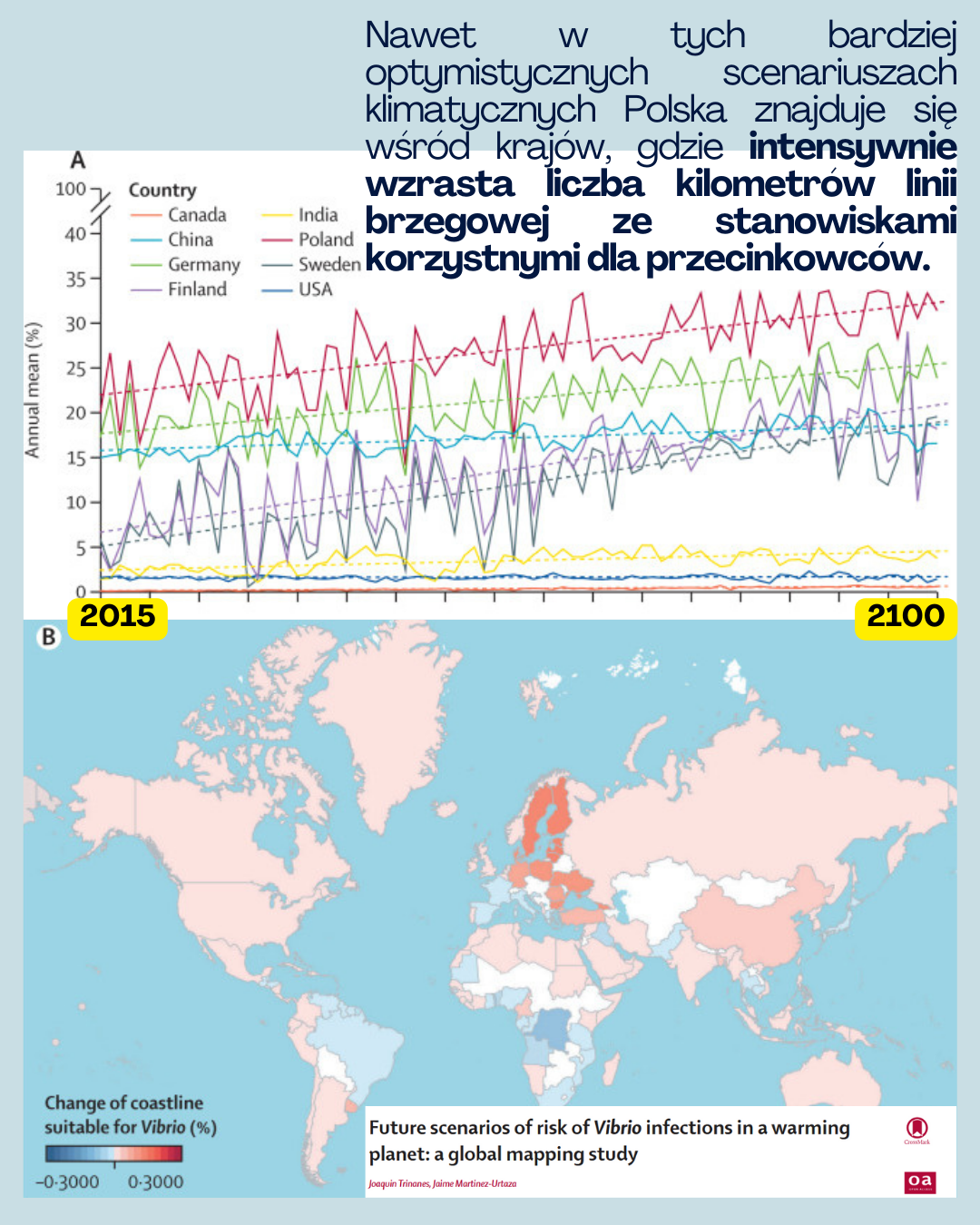
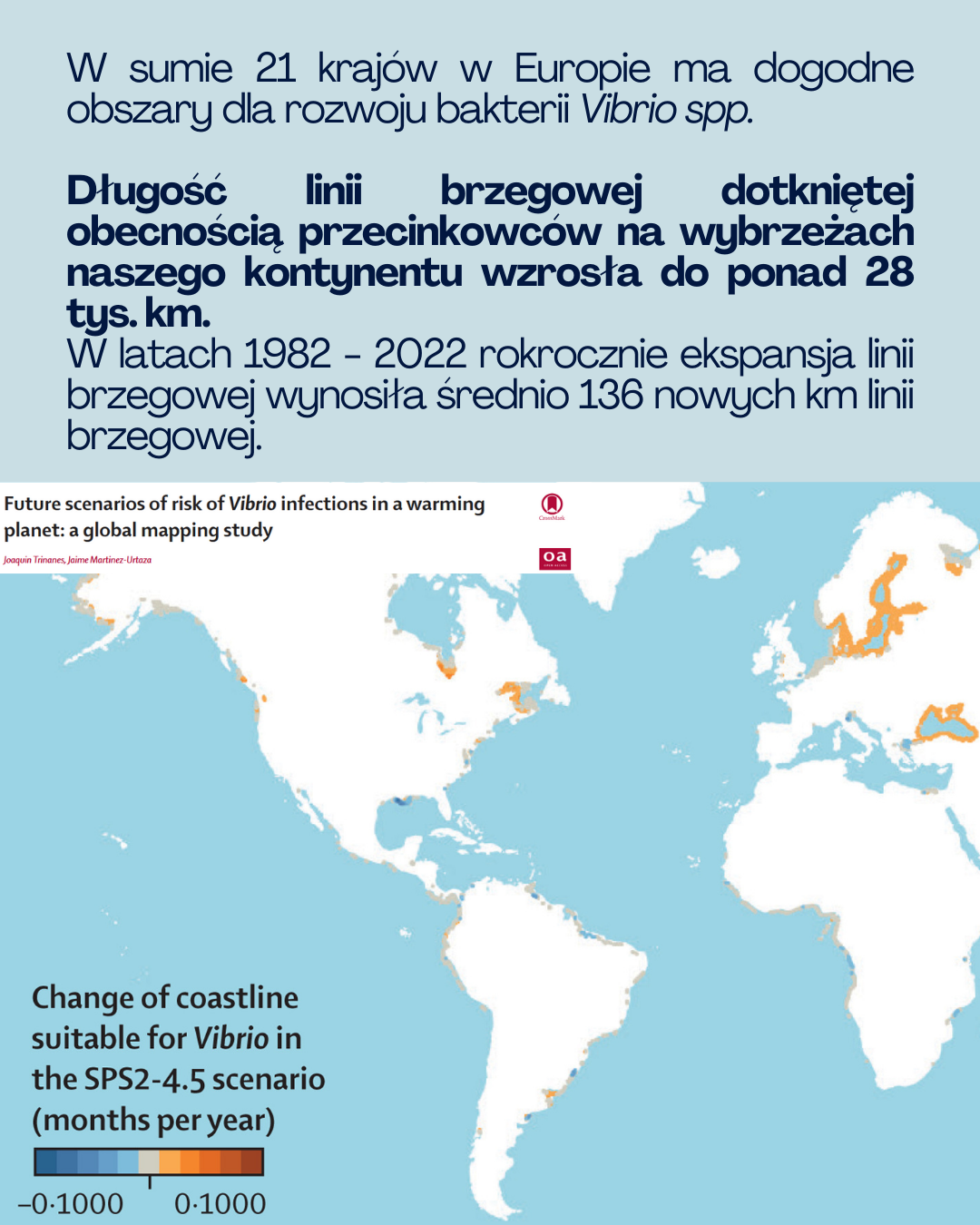
Źródła: Future scenarios of risk of Vibrio infections in a warming planet: a global mapping study https://pmc.ncbi.nlm.nih.gov/articles/PMC9284918/

Impact of climate change on waterborne infections and intoxications https://pmc.ncbi.nlm.nih.gov/articles/PMC10278370/

Climatic changes and their role in emergence and re-emergence of diseases: https://link.springer.com/article/10.1007/s11356-020-08896-w

Climate Change and Cholera: A Review Exploring the Association Between Storm Severity and Global Human Vibrio spp. Incidence https://doi.org/10.52504/001c.116783

Stemming the rising tide of Vibrio disease https://www.thelancet.com/journals/lanplh/article/PIIS2542-5196(24)00124-4/fulltext

How climate change can affect cholera incidence and prevalence? A systematic review
https://link.springer.com/article/10.1007/s11356-020-09992-7

Climate Change and Cascading Risks from Infectious Disease https://link.springer.com/article/10.1007/s40121-022-00647-3

The 2024 Europe report of the Lancet Countdown on health and climate change: unprecedented warming demands unprecedented action https://reports.weforum.org/docs/WEF_Global_Risks_Report_2025.pdf

Global expansion of Vibrio spp. in hot water https://pmc.ncbi.nlm.nih.gov/articles/PMC10103853/

Epidemiological and environmental investigation of the ‘big four’ Vibrio species, 1994 to 2021: a Baltic Sea retrospective study https://pmc.ncbi.nlm.nih.gov/articles/PMC11312017/

Dodaj komentarz